
Article: Father of the Bride Suit: A Liverpool Tailor's Guide to Getting It Right

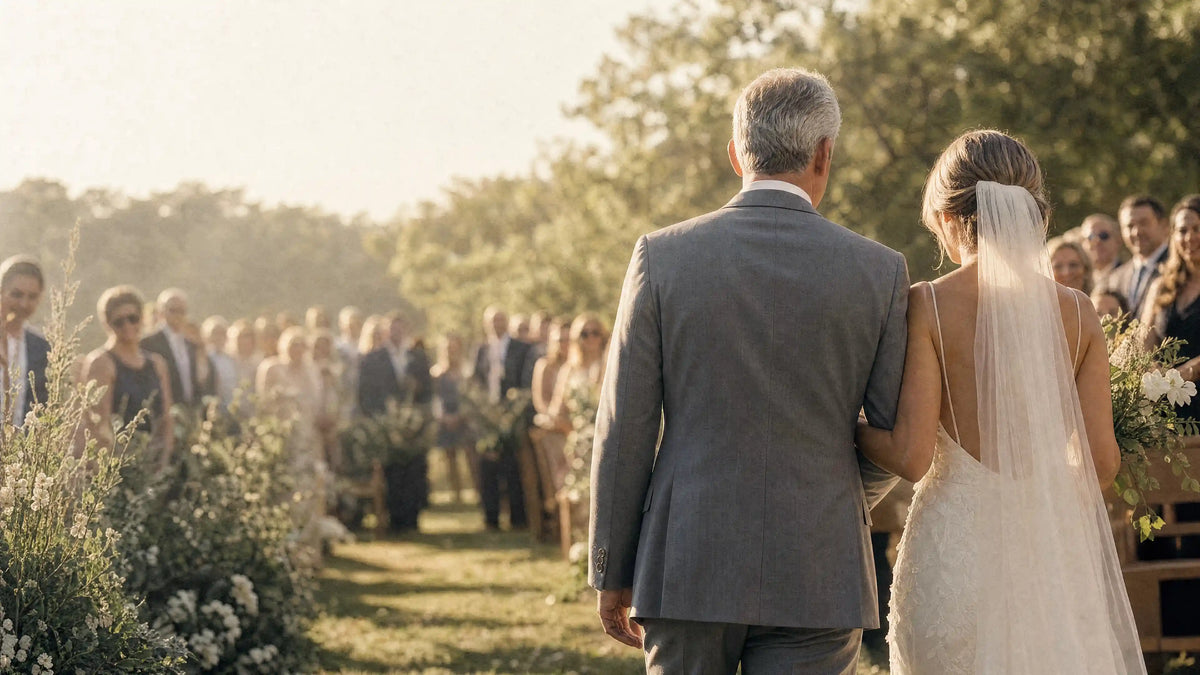
Father of the Bride Suit: A Liverpool Tailor's Guide to Getting It Right
The father of the bride should wear a well-fitted mid-grey or blue-grey suit, ideally a three-piece, in a cloth suited to the season, unless the invitation calls for morning dress or black tie. Coordinate with the bride's palette through your tie and pocket square rather than copying the groom, avoid black and anything loud, and start at least three months out so there's time to get the fit right.
You have one job in the photographs. Look like the man who raised her.
That sounds simple until you're standing in a fitting room three weeks out, holding a jacket that fits across the shoulders but pulls at the button, wondering why nothing on the rail accounts for the fact that you'll spend the day with your arm around people. I've been dressing fathers for ten years. The mistakes are always the same, and they're always avoidable.
This is what I'd tell you over coffee before we started.

The role you're actually dressing for
A groom dresses to be looked at. You dress to be looked with.
You walk her down the aisle. You stand for photographs at the top of the day and again at golden hour. You give a speech. You dance, badly, in front of people who've known you for thirty years. The suit has to survive all of it without you thinking about it once.
That's the brief. Not "make me look good," but "make me forget I'm wearing anything at all, while everyone else remembers exactly how I looked."
The men who get this wrong treat the suit as decoration. The men who get it right treat it as equipment, built for a specific day, a specific body and a specific set of movements.
Start with the wedding, not the suit
Before fabric, before colour, before any of it, I ask four questions. You should ask yourself the same ones.
What's the dress code? Morning dress, a lounge suit and black tie are three different garments. If the invitation says morning dress, you wear morning dress: tailcoat, sponge-bag trousers, the lot. Most Liverpool weddings now run lounge suit, which gives you room. But check before you assume.
Where is it, and when? A July wedding at Thornton Manor with a marquee on the lawn is a different problem from a December ceremony at the Town Hall. One needs a fabric that breathes, the other needs weight and warmth. I've watched fathers sweat through a wool chosen for a winter wedding because nobody asked them what month it was.
What's the bride wearing, and what's the palette? You're not matching the groom. You're coordinating with a colour story the bride has already decided. Ask her. She'll have a swatch, a Pinterest board and a very firm opinion. Your tie, your pocket square and the tone of your cloth all sit inside that story, not against it.
Who else is in the formal photographs? If the groom is in navy and the best man is in navy, a fourth man in navy turns the family line into a uniform. You want to belong to the group and still read as her father. That's a question of tone and texture, not a different colour entirely.
Answer those four and most decisions make themselves.
Choosing fabric: weight before colour
People choose cloth by colour and discover the weight too late. Reverse it.
Suit cloth is measured in grams per metre, or in the older ounce system. A summer cloth sits around 230–270g; a winter cloth runs 320g and up. The number tells you how the suit behaves on the day: whether it breathes, whether it holds a crease, and whether you spend the reception quietly overheating.
For a warm-weather Liverpool wedding (our summers are kinder than people admit), I reach for a high-twist wool, often a fresco or fresco-type weave from Vitale Barberis Canonico or Holland & Sherry. The yarn is twisted tightly and woven open, so air moves through it. It resists creasing when you sit for the meal and stand for the speeches, and it photographs clean.
For autumn and winter, flannel earns its place. A mid-weight flannel from Loro Piana or Piacenza has a soft surface that reads warm in photographs and feels substantial without being heavy. Worsted flannel holds a sharper line if you want more structure.
If you want a little light in the cloth for an evening reception, a wool-mohair blend from Scabal gives a quiet sheen without crossing into anything flashy. Mohair adds crispness and a faint lustre. At around 10–15% it lifts the cloth in low light. Used heavily, it looks like a tuxedo trying too hard.
The mills I work with (Holland & Sherry, Scabal, Loro Piana, Vitale Barberis Canonico and Piacenza) each have their own character. I'll show you cloth in your hand and in the light you'll actually wear it in, because a swatch under a shop's downlights tells you nothing about how it sits at four o'clock in June.

What colour suit should the father of the bride wear?
Black is for funerals and black tie, and a wedding day is neither. It also photographs flat and severe in daylight. Leave it.
Your strongest options are grey and blue. The question is which version.
Mid-grey is the most useful colour a father can own. It's softer than navy in daylight, flatters most complexions, and photographs beautifully against almost any palette the bride has chosen. A mid-grey three-piece is, for my money, the most reliable father-of-the-bride suit there is.
Blue-grey, a grey with blue drawn through it, sits between the two and solves a specific problem. If the groom is in navy and you want to belong to the family without disappearing into it, blue-grey keeps you in the same world while letting you read as distinct.
Soft brown or tobacco works for a rural or autumn wedding, especially against greenery, stone and warm light. It's less expected, which is the point. At a country-house wedding in October, brown can be the most considered choice in the room.
Avoid anything loud. You're not the focal point, and a strong check or saturated colour pulls the eye in family photographs where it shouldn't go. Pattern, if you want it, belongs at the level of a quiet windowpane or a faint herringbone you only notice up close.
Why a three-piece suit earns its place
A waistcoat does two things for a father that a two-piece can't.
First, you'll take your jacket off. Of course you will: the meal, the dancing, the warm room at nine o'clock. A two-piece in shirtsleeves looks half-dressed. A three-piece in shirtsleeves still looks finished, because the waistcoat holds the line of the outfit even when the jacket's on a chair.
Second, it photographs with more presence. The waistcoat draws a clean vertical, narrows the eye's read of the torso, and gives the formal portraits a sense of occasion a plain two-piece doesn't reach.
If the dress code is morning dress, the waistcoat is non-negotiable anyway. If it's lounge suit, the three-piece is the upgrade I recommend more than any other.
How a father of the bride suit should fit
I trained alongside Savile Row cutters, and the lesson that stayed with me is that fit isn't about being tight. It's about being correct, which means the suit follows your body through movement, not just standing still in a mirror.
Here's what correct means in the places that matter most on your day.
The shoulder. This is the one thing a tailor genuinely can't fake, and the first thing the eye reads. The shoulder seam should sit where your shoulder ends, and the line from neck to sleeve should be clean. A divot or ripple here tells everyone the jacket was built for a different man. Everything else can be adjusted. This must be right from the start.
The collar. The jacket collar should hug the back of your neck and stay there when you raise your arms to hug your daughter. A collar that lifts away, a "collar gap," is the most common fault I correct, and it ruins every photograph taken from behind, of which there will be many.
The chest. The jacket should close without strain and without the button pulling a horizontal crease, what we call an X-pull. You're going to embrace a lot of people. The chest has to allow for that.
The sleeve and cuff. About half an inch of shirt cuff should show below the jacket sleeve. It's a small thing that reads instantly as a man who knows how he should look. On a bespoke jacket I'll give you working cuff buttonholes, the surgeon's cuff, because the detail rewards a closer look.
The trousers. A clean break over the shoe, with no pooling of fabric and no riding up when you sit for the speeches. You'll be photographed seated at the top table, and the trousers have to behave there too.
This is where measurements become a system rather than a guess. The drop, the difference between your chest and your waist, tells me how the jacket and trousers relate. Your posture, the way you hold one shoulder slightly higher than the other, and the way you stand when you're relaxed versus performing all go into the pattern. That's the engineer in me. A body is a set of measurements that move, and the suit is the solution to that set.

Bespoke, made-to-measure or off-the-peg?
Three routes, three honest trade-offs. I'll tell you when each one makes sense, including when bespoke doesn't.
Off-the-peg is a finished suit altered to fit. It's the fastest and the cheapest. If your build is close to a standard pattern and your timeline is short, a good off-the-peg suit with proper alterations can serve you well. The limit is the shoulder and the chest. If the base garment is wrong there, no alteration fixes it.
Made-to-measure starts from an existing pattern adjusted to your measurements. It's more accurate than off-the-peg, and faster and less costly than full bespoke. For many fathers, this is the sensible middle.
Bespoke is a pattern cut from scratch for your body alone: hand-cut, fitted in stages, and adjusted at each fitting until the suit follows you exactly. It's the most expensive and the slowest, and it's the right choice when your build is hard to fit off a standard pattern, when you want a garment you'll wear for years beyond the wedding, or when the day matters enough that you want it solved completely.
I build bespoke to a particular standard: a hand-cut pattern, a floating canvas chest and hand-worked silk buttonholes. The floating canvas matters more than any label. Cheaper suits glue, or fuse, the front structure to the cloth, and under the heat you'll generate on a wedding day, fused fronts can bubble and the chest goes flat. A floating canvas is stitched, not glued. It moves with you, breathes, and holds its shape across the day and across the years. It's the difference between a suit that photographs well at noon and one that still photographs well at ten that night.
I'm not going to tell you every father needs bespoke. I will tell you that the shoulder, the collar and the chest decide whether you look right, and that those are exactly the things the cheaper routes struggle with. Choose the route that solves those three for your body.
How far in advance to order a father of the bride suit
This is where good intentions go to die. The day is in the diary for a year, and the suit gets handled with six weeks to go.
Here's the honest schedule.
- Bespoke: six to eight weeks. That covers consultation, cloth selection, the cut, and two or three fittings with adjustments in between. Rush it and you lose the fittings that make bespoke worth doing.
- Made-to-measure: four to six weeks. Less margin, but enough for one fitting and a correction.
- Off-the-peg with alterations: two to three weeks, if the base suit is in stock and the alterations are routine.
Start sooner than you think you need to. Cloth can be out of stock. A fitting can reveal something that needs a fortnight to put right. And your daughter will, at some point, change her mind about the palette, which may change your tie, your square or the tone of your cloth. Margin protects you from all of it.
If the wedding is more than three months out, you have time to do it properly. If you're inside six weeks, we work to what's possible, and made-to-measure or a well-altered off-the-peg suit becomes the sensible answer.
Coordinating with the groom without matching him
You sit inside a group of men: the groom, the best man, perhaps the groom's father. The aim is harmony, not uniform. A few rules I work to:
Don't copy the groom exactly. If he's chosen navy with a specific tie, sit near that world without replicating it. Same family, different note: a blue-grey to his navy, a different texture, a tie that complements rather than copies.
Join the bride's palette through your tie and pocket square, not your suit colour. The suit is your foundation. The accessories are where you join the colour story: a square that echoes the bridesmaids' tone, a tie that sits beside it. Small, deliberate, photographed.
Mind the mother of the bride. If she's in a strong colour, your accessories should sit comfortably beside hers in the photographs you'll share. It's worth a two-minute conversation before anyone commits.
Keep metals and leathers consistent across belt or braces, shoes and watch strap. A brown shoe with a grey suit is correct and warm; black shoes pull more formal. Decide the whole picture, not the suit in isolation.
Shoes, shirt and the small things
The suit is most of it. The rest is quick.
Shirt: white or a soft pale blue, in a fabric with body, such as a crisp poplin or fine twill.