Article: Bespoke vs Made-to-Measure in Riyadh: Which Do You Actually Need?
Bespoke vs Made-to-Measure in Riyadh: Which Do You Actually Need?
The difference between bespoke and made-to-measure is the pattern. Made-to-measure takes an existing block pattern and adjusts it to your measurements, usually with one fitting. Bespoke drafts a new pattern from scratch for your body alone, is largely finished by hand, and is refined over several fittings. Made-to-measure is a sensible first step up from off-the-rack. Bespoke is the right choice if you're hard to fit, the occasion matters, or you'll keep the suit for years.
I get asked this almost as often as I get asked about price. A man sits across from me at his office in KAFD, or in the front room of his villa in Al Nakheel, and says, "Michael, be honest with me. What's the actual difference between bespoke and made-to-measure? And does it matter for me?"
It's a fair question. The two terms get used as if they mean the same thing. They don't. And the confusion isn't harmless. It costs men money, and more often it costs them the fit they were promised but never received.
So let me explain it the way I do in a consultation: plainly, with no sales spin, so you can decide what's right for where you are now.
What made-to-measure actually is
Made-to-measure starts with a pattern that already exists. The tailor takes a standard block, a base template built for an average frame, and adjusts it to your measurements. He lets out the waist, shortens the sleeve, drops the trouser length, takes in the chest.
That's a real improvement over buying off the rack. The garment is shaped closer to your body, you usually get a choice of fabric and a few details, and it comes together faster, often with a single fitting. For many men, it's a sensible first step up.
But understand what it is. It's a good pattern adjusted toward you. It isn't a pattern built from you.
What bespoke actually is
Bespoke begins with nothing. No block, no template. I draft a pattern from scratch using only your body as the reference: your measurements, your posture, the slight drop of one shoulder, the way you stand when you're tired at the end of a long day of meetings.
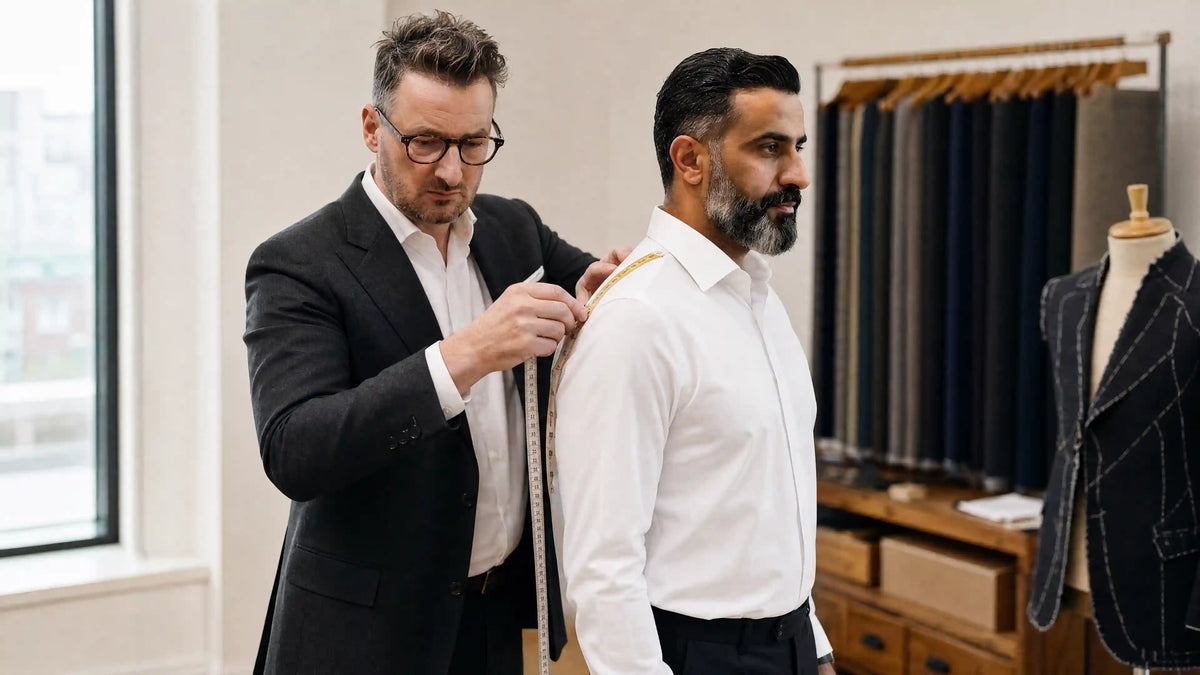
The cutting and construction happen in my Liverpool workroom, where the chest canvas is hand-padded, the lapels hand-shaped and the buttonholes worked by hand in silk twist. Then I bring the suit to Riyadh and fit it on you in person, adjusting the shoulder, sleeve, waist and trouser break until the suit stops feeling like something you put on.
That's the real divide. Made-to-measure is a better version of an existing thing. Bespoke is a different thing entirely.
Bespoke vs made-to-measure: the key differences
| Made-to-measure | Bespoke | |
|---|---|---|
| Pattern | A standard block adjusted to your measurements | Drafted from scratch for you alone |
| Fittings | Often one | Several, because refinement is the point |
| Construction | Mostly machine-made | Largely hand-finished, so it holds its shape and lasts |
| Choices | A set menu of options | Fabric, lining, lapel and silhouette all open |
| Time | Faster | Six to eight weeks from consultation to final fitting |
| Cost | Lower | Higher, because of everything above |
Which one do you actually need?

This is the part most tailors skip, so I won't.
You don't always need bespoke. If you're buying your first properly fitted suit and want to understand what good feels like before committing further, made-to-measure can be the right starting point. There's no shame in it.
But there are situations where made-to-measure will quietly let you down, and where I'll tell a man plainly that he needs bespoke.
If standard sizes never sit right on you. Whether it's your shoulders, an athletic build, your posture, or simply the Saudi or Arab frame that off-the-rack patterns were never drawn for, an adjusted block can't fully solve it. A pattern built from your body can.
If the suit has a job to do. A board appointment, a major negotiation, your wedding: in the rooms where how you appear is remembered long after what you said, the margin between "fits well" and "fits like it grew on you" is worth paying for.
If you'll keep the suit for years. A well-made bespoke suit, properly cared for, lasts fifteen to twenty years. Spread the cost across that life and the price per wear is lower than most men expect.
Bespoke vs made-to-measure in Riyadh's climate
Off-the-rack suits, and many made-to-measure ones, were never built for Riyadh. They weren't drawn for forty-degree heat, for constant movement between the sun and cold air conditioning, or for the physical reality of the men I dress here.
The right cloth, such as lightweight wool around 260–280g, tropical wool or high-twist cloth from mills like Holland & Sherry, Scabal and Loro Piana, helps in either category. But a standard block adjusted to your size still doesn't account for how you move through a Riyadh day. Bespoke lets me build the climate into the garment from the first cut.
The honest bottom line
Made-to-measure and bespoke both beat off-the-rack. The difference is the foundation. Made-to-measure improves a pattern that already exists. Bespoke creates one that never did, drawn entirely from you, finished by hand and fitted in person.
If you want a solid, well-fitting suit and you're testing the water, made-to-measure is a reasonable place to begin. If your wardrobe is a professional asset, if you're hard to fit, or if the occasion genuinely matters, bespoke isn't an indulgence. It's the correct tool.
I didn't start as a tailor. My first career was in electrical engineering, where the logic is simple: when something is built correctly it works, and when it isn't, nothing fixes it afterwards. Ten years of tailoring has only confirmed that. A suit built from your own pattern works. One adjusted toward you only approximates it.
If that resonates with where you are now, I'd like to have the first conversation. I come to you, at your office in KAFD, your home, or my studio in Wadi Qortuba. No malls, no queues, no appointments lost to Riyadh traffic.
Arrange a private consultation in Riyadh →
Frequently asked questions
What is the difference between bespoke and made-to-measure?
Made-to-measure adjusts an existing block pattern to your measurements, usually with one fitting. Bespoke drafts a completely new pattern from your body and posture, is largely hand-finished, and is refined over several fittings.
Is made-to-measure good enough, or do I really need bespoke?
For many men, made-to-measure is a sensible first step, and I'll say so honestly. You only truly need bespoke when standard patterns never sit right on your frame, when the occasion genuinely matters, or when you intend to keep the suit for many years. If none of those apply yet, don't let anyone push you up the ladder before you're ready.
Will I actually notice the difference?
Yes, and so will the people in the room with you. With made-to-measure, the suit fits. With bespoke, it disappears, in the best sense: no pulling at the shoulder, no gaping at the collar, no fighting the jacket when you reach across a table. Riyadh's Saudi and expat business communities are educated observers of quality, and they notice.
Why does bespoke cost more if both are custom?
Because you're paying for a different process, not a fancier label. Made-to-measure adjusts an existing pattern, mostly by machine. Bespoke is drafted from nothing, cut for your body alone, and largely finished by hand, with a hand-padded canvas, hand-shaped lapels and hand-worked buttonholes. The price reflects the labour and the longevity, not the marketing.
How long does each take?
Made-to-measure is faster, often with a single fitting. A bespoke suit from me takes six to eight weeks from first consultation to final fitting. If you have a wedding or a major business event coming up, tell me the date at the start and we'll work out what's possible.
Which is better for Riyadh's heat?
The cloth matters more than the category, but bespoke gives me more control over building the climate into the garment. I recommend lightweight wool around 260–280g, tropical wool or high-twist cloth that resists creasing. A standard block adjusted to your size doesn't account for the heat or for your frame. Bespoke accounts for both from the first cut.
I've been fitted before and suits still never sit right. Why?
This is the single clearest case for bespoke. If your shoulders slope, your posture is unusual, or your build doesn't match the average frame that off-the-rack and made-to-measure blocks are drawn for, an adjusted template can only get you so far. A pattern built from your body, rather than toward it, solves problems adjustment alone can't.
Can you tell me which one I need before I commit?
That's exactly what the first consultation is for. I don't begin with measurements. I begin with questions: the rooms you're in, the occasions that matter, how you're built and what you want the suit to do. By the end, I'll tell you honestly whether you need bespoke or whether made-to-measure will serve you well for now.
Do you work with Saudi clients and expats?
Both. Many of my Riyadh clients are Saudi founders, principals and business owners, alongside expat executives, diplomats and senior professionals. The process is the same for everyone: private, discreet, and built around the life you actually lead.
Where do the fittings happen?
I come to you: your office in KAFD, your home, or my studio in Wadi Qortuba. No malls, no queues, no appointments lost to Riyadh traffic.
Can you make a bespoke wedding suit in Riyadh?
Yes. I work with grooms and groomsmen for weddings in Riyadh and internationally. Wedding tailoring has its own consultation, fitting schedule and event-day timeline, so the earlier you contact me with your date, the better.