What to Wear as an Expat Executive in Riyadh: A Tailor's Guide
As an expat executive in Riyadh, wear a precisely cut suit in lightweight, high-twist wool, in a restrained palette of charcoal, navy, mid-grey, stone or soft tobacco. Avoid heavy English worsteds, black and loud colours, and keep linen for evenings. Three well-made suits cut for the climate will serve you better than eight brought from your old posting.
Most expat executives I meet in Riyadh are dressed wrong. Not badly. Wrong. The suit that worked in Frankfurt, Singapore or Canary Wharf doesn't work here, and the men wearing it can usually feel it before they can name it.
That gap, between knowing something is off and knowing what to fix, is what this piece is for.
I cut for clients in two cities: Liverpool, from my studio at the Royal Albert Dock, and Riyadh, from Wadi Qortuba. I see the same man in both. He arrives in the Kingdom on a three-year posting with a wardrobe built for a different climate and a different room, and within four months realises his suits are working against him. Heat. Light. Local protocol. The weight of who he's sitting opposite.
Let me walk you through what actually works for everyday professional life here, and why.
Why your London wardrobe doesn't work in Riyadh
Riyadh isn't London with sun. It's a different brief entirely.
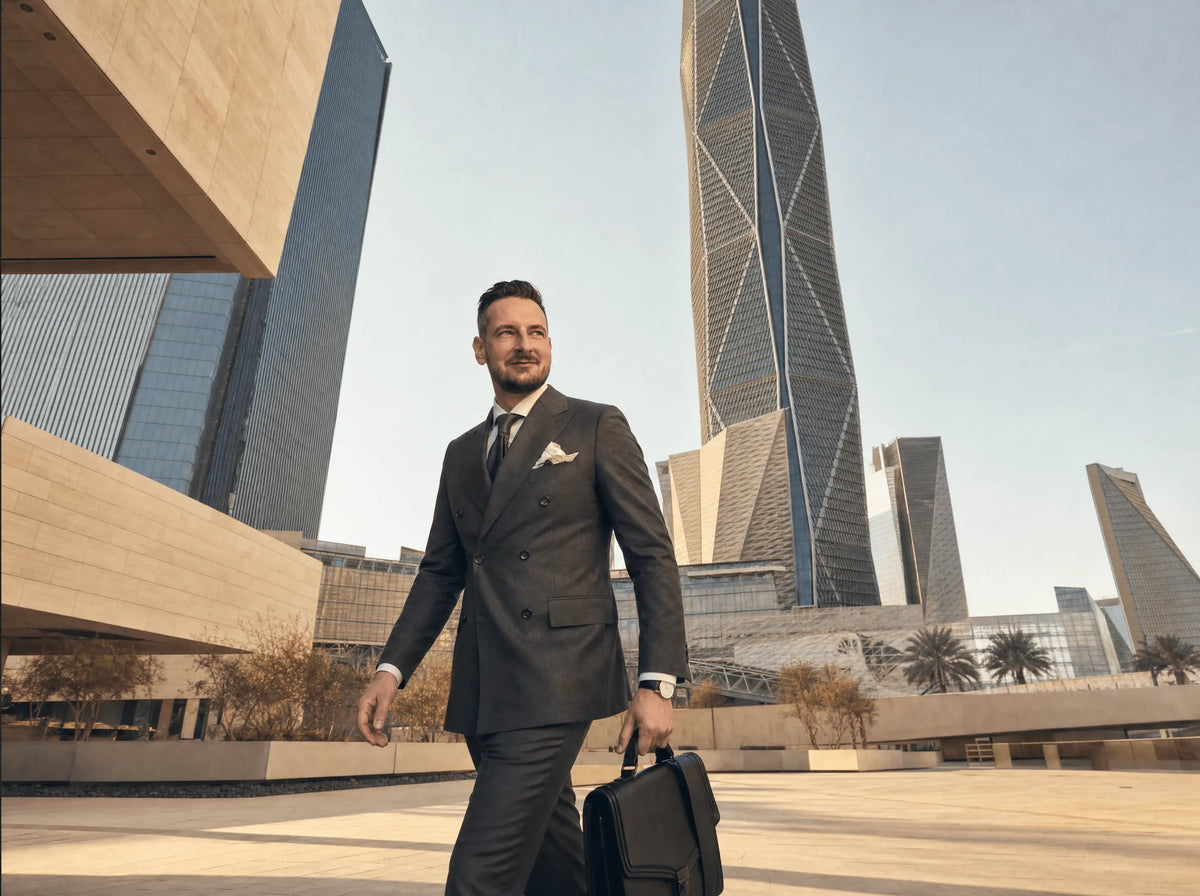
In London, your suit absorbs the room: soft light, cool air, a conservative palette. A navy worsted does its job and disappears. In Riyadh, the suit is interrogated. The light is harder, the air is hotter for nine months of the year, and the men you're meeting, whether at KAFD, in Al Olaya or in a majlis in a private home, read clothing with more precision than most Western executives realise.
A poorly cut jacket reads as carelessness. A heavy English worsted reads as ignorance of the climate. A flashy lining reads as trying too hard. None of these is recoverable in a first meeting.
What works is the opposite: a cut that fits the body precisely, cloth chosen for the weather, and restraint in the details. That's the entire game.
How to dress for business in Riyadh
1. Choose the cloth before the cut
I start every Riyadh consultation with the cloth book, not the measuring tape. The most common error I correct is a suit cut for British weather being asked to perform in Saudi heat. It can't.
For Riyadh clients I work mostly with high-twist wools from Holland & Sherry's Crispaire and Cool Breeze books, the lighter end of Vitale Barberis Canonico's tropical range, and selected Piacenza cloths for the warmer months. Riyadh does have a winter, between December and February, and then a mid-weight from Scabal or a Loro Piana flannel earns its place.
Linen has a role, but a narrow one. It creases. For a director or managing partner sitting through four meetings before lunch, linen is a liability. I'll cut linen for evenings and weekends, rarely for the boardroom.
2. Insist on construction that survives the climate
A floating canvas chest is non-negotiable in this climate. Fused jackets, where the front is glued rather than stitched, are prone to bubbling in heat. I've seen it on men in Riyadh more times than I can count, and once it happens it's very difficult to fix.
Every jacket I cut has a hand-padded canvas chest that moves with the body. Hand-worked silk buttonholes. Patterns cut from paper for that client, kept in my archive, and refined with each commission. This is the standard I trained to alongside Savile Row cutters, and I haven't relaxed it in either studio.
3. Wear a palette that respects the room
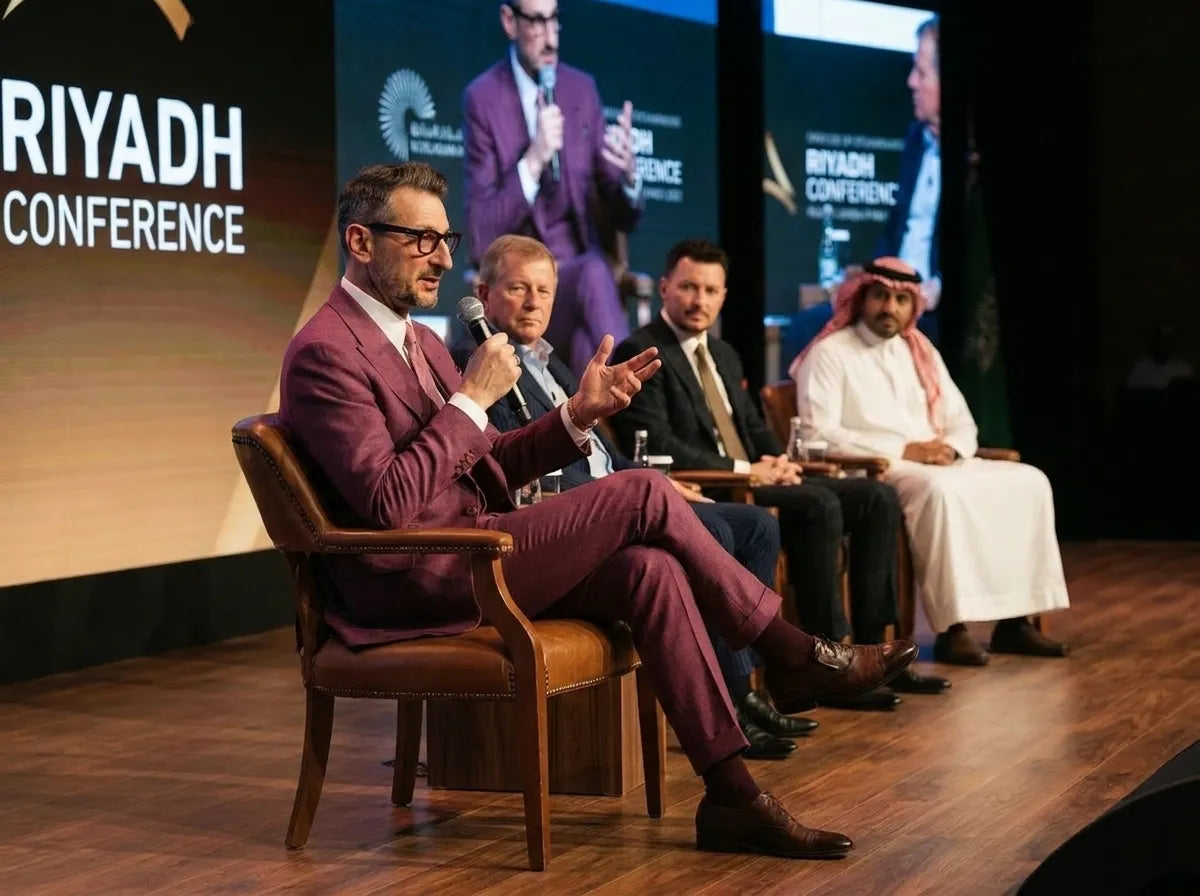
Charcoal, navy, mid-grey, stone and soft tobacco. Those five colours carry ninety percent of a serious executive wardrobe in Riyadh, from the office to a conference floor like FII.
I steer clients away from black, which photographs badly in Saudi light and feels funereal in daylight meetings, and away from the loud blues that have crept into European corporate dress over the last decade. A diplomat or senior CEO doesn't need his suit to announce him. The cut and the cloth do that work quietly.
4. Cut for the man, not the trend
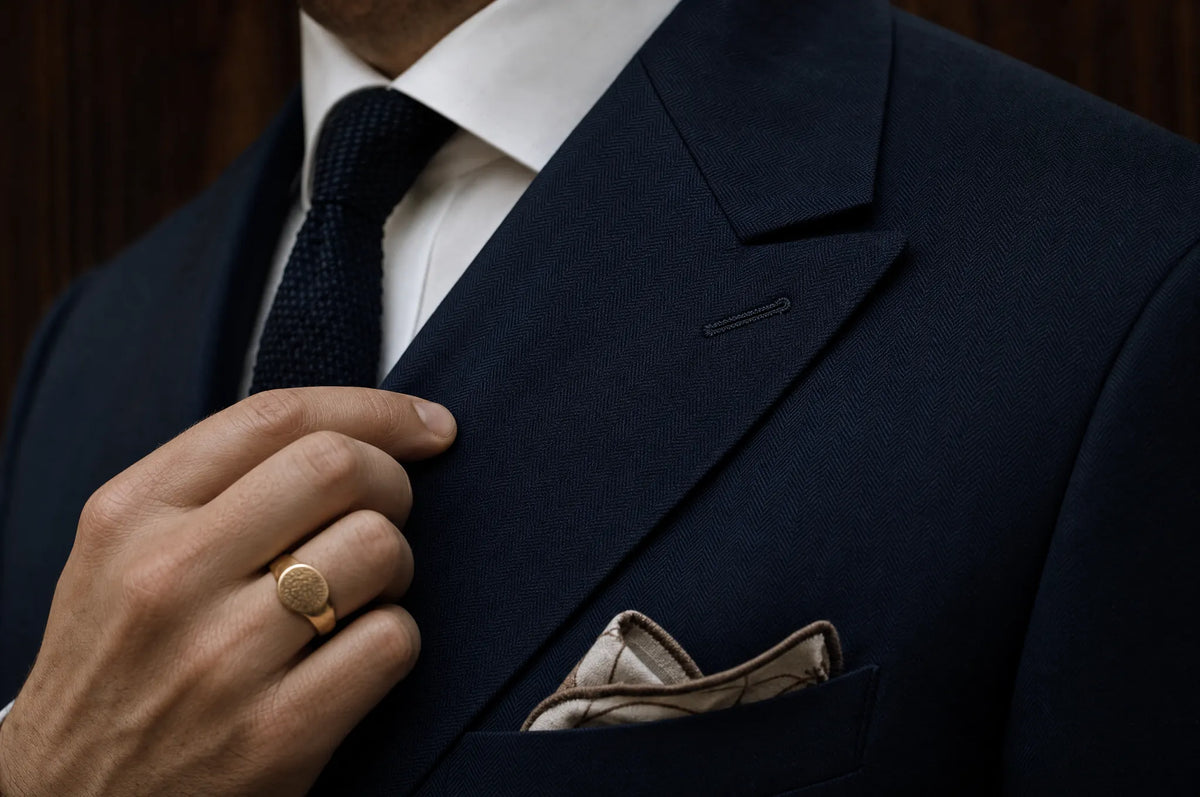
A jacket that fits the shoulder, releases at the waist and sits clean over the seat. A trouser break calibrated to the shoe, not to a magazine. A sleeve that shows a quarter-inch of shirt cuff and no more.
These aren't stylistic opinions. They're measurements, and they're either right or wrong on your frame. Trends are how off-the-peg houses sell you a second suit. They have no place in bespoke.
5. Expect a process built around your diary
I don't have a shop floor. I never have. Consultations happen at your home, your office, or one of my two studios, at the Royal Albert Dock in Liverpool and Wadi Qortuba in Riyadh, by appointment only.
A first commission runs across at least three fittings and takes six to eight weeks. The pattern is cut by hand for you and archived, so every later commission is faster, because the pattern already knows your body.
That relationship, tailor and client over years rather than a transaction over an afternoon, is what bespoke actually means.
For the expat executive on a three-year posting
If you've arrived from London, Zurich or Singapore, here's the honest version of what to do.
Bring one or two of your existing suits and wear them for the first month. You'll learn quickly which fabrics fail you and which cuts feel wrong in the new context. That's more useful than any advice I can give you cold.
Then commission properly. Three suits cut to a Riyadh brief (high-twist wool, mid-weight construction, restrained palette) will replace eight suits from your old wardrobe and serve you better. A senior legal or finance professional posted to KAFD doesn't need a deeper wardrobe than that. He needs three suits that work, not eight that nearly do.
I see clients at home, at their office in KAFD or Al Olaya, or at my Wadi Qortuba studio, whichever is least disruptive to the diary.
For the founder building something in the Kingdom
If you're a Saudi founder scaling a business, or an expat building a venture here, your wardrobe is part of your capital. I say that without dramatising it.
The people you're raising money from, partnering with or hiring read you in the first ninety seconds. A suit that fits, in cloth suited to the climate and a palette that respects the setting, removes one variable from that judgement. It won't win the meeting for you. It stops you losing it before you've spoken.
I dress a number of founders working out of Al Olaya and Al Nakheel. The brief is consistent: serious cloth, quiet palette, faultless cut, nothing that looks like it's trying. Two suits, three shirts and a blazer-and-trousers combination will carry a founder through almost any week here.
"Shouldn't I just fly to London?"
This is the question I'm asked most, so I'll answer it directly.
If you want to be measured on Savile Row, fly to Savile Row. The houses there are excellent at what they do, and I won't pretend otherwise.
But I trained alongside those cutters, and my construction standard is the same: hand-cut patterns, floating canvas, hand-worked buttonholes, and mills like Holland & Sherry and Scabal. The difference is that I'll see you in your Riyadh office on a Tuesday morning or at your home on a Friday afternoon, and again for the next fitting three weeks later, without you boarding a plane.
For a managing partner whose time costs more per hour than the suit itself, that tends to settle the question.
A checklist before you commission anything in Riyadh
Use these questions on any tailor you're considering, including me.
- What weight of cloth do you recommend for Riyadh between April and October, and which mill is it from?
- Is the chest canvas floating and hand-padded, or fused?
- Will my pattern be drafted from scratch, or adjusted from a block as with made-to-measure? Will it be kept on file for future commissions?
- How many fittings are included, and over what timeframe?
- Where will the fittings happen, and who conducts them?
- Can I see finished work on a client of similar build, with permission?
- What is your standard for buttonholes, linings and internal finishing?
If any answer is vague, you have your answer.
Frequently asked questions
What should an expat executive wear to work in Riyadh?
A well-cut suit in lightweight, high-twist wool, in charcoal, navy, mid-grey, stone or soft tobacco. Avoid heavy worsteds, black and loud colours. Fit and restraint matter more here than in most European business cities.
How many suits do I need as an executive in Riyadh?
Three, cut properly, will serve most of my clients. A charcoal, a navy and a mid-grey cover ninety percent of working life. Add a stone or soft tobacco for warmer-weather meetings and you have a complete wardrobe.
What's the lightest suit cloth I can wear and still look serious?
A high-twist wool in the 240–280g range, with Holland & Sherry's Crispaire as the reference point. It wears cool, holds its shape and reads as a proper suit. Anything lighter starts to look casual.
Can you accommodate a thobe-and-suit lifestyle?
Yes. Several of my Saudi clients wear the thobe in some settings and a suit in others. The wardrobe is built around that reality, not in spite of it.
How long does a first commission take?
Six to eight weeks across three fittings. Later suits, once your pattern is established, are faster.
Is bespoke worth it if I'm only posted here for three years?
A bespoke suit, looked after, lasts fifteen to twenty years. Your posting ends. The wardrobe doesn't.
How much does a bespoke suit cost in Riyadh?
My Riyadh commissions start from SAR 8,500, which includes a private consultation, a fully bespoke suit, a bespoke shirt and a personalised wardrobe plan. It's not the cheapest option in the city, and not the most expensive. It reflects the construction, the cloth and the hours.
Do you travel between Liverpool and Riyadh?
Yes, on a regular schedule. Clients can be seen in either studio, or at their home or office in either city.
What does the first conversation look like?
A coffee, about forty-five minutes. No measuring tape at the first meeting unless you want one. I want to understand your week, your meetings, your existing wardrobe and what's failing in it before I talk about cloth.
Do you work with grooms?
Yes, mainly in Liverpool, where I dress a number of grooms each year, typically six to eighteen months before the wedding. The standard is the same.
Let's start with a conversation
I'm not trying to sell you a suit in this article. I'm trying to give you a clearer view of a decision most expat executives in Riyadh make once and live with for years.
If what I've written matches how you think about your work, your time and the standard you hold yourself to, we should talk. Not a booking, a conversation: coffee at your office in KAFD, your home in Al Nakheel, or my studio. Forty-five minutes. No tape measure unless you ask for one.
Arrange a conversation in Riyadh →
You can also find me on Instagram at @michael_frackowiak. The studios are at the Royal Albert Dock in Liverpool and Wadi Qortuba in Riyadh.
For men whose presence carries consequence.
Michael