Article: £500 vs £5,000 Suits, Explained: What You're Actually Paying For
£500 vs £5,000 Suits, Explained: What You're Actually Paying For
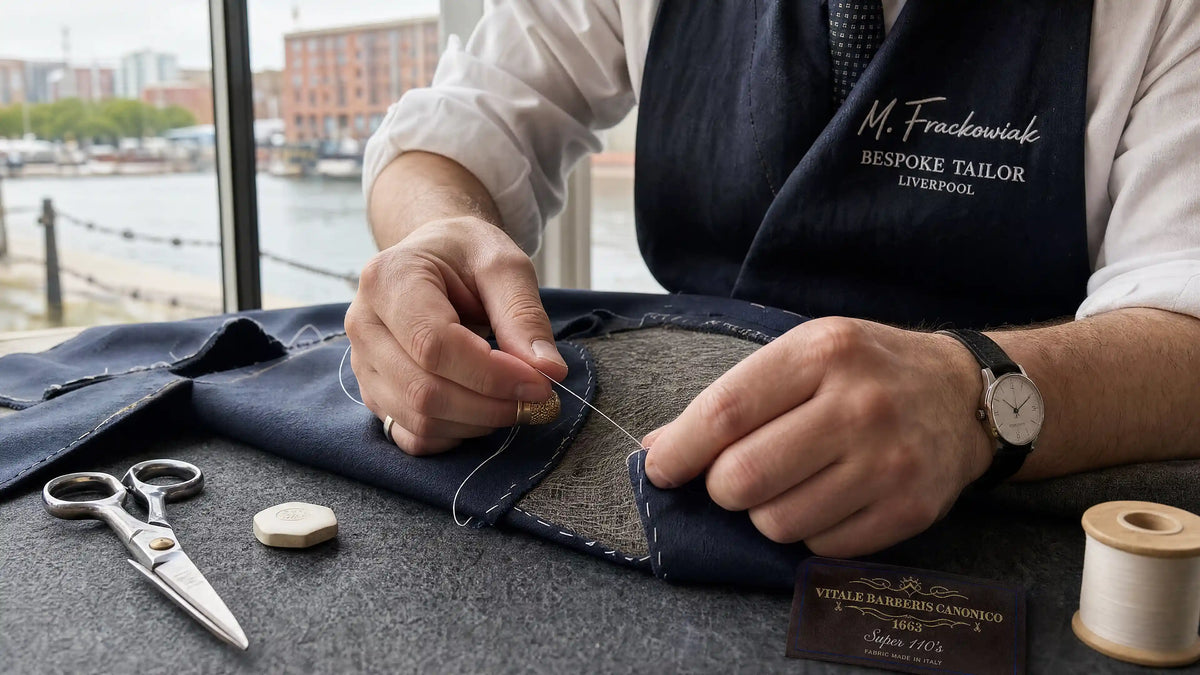
The difference between a £500 suit and a £5,000 bespoke suit is in five places: the shoulder, the chest construction, the cloth, the buttonholes and the hours. A £500 suit is factory-cut and glued through the chest in a few hours. A bespoke suit is cut from a pattern drafted to your body, hand-stitched over a floating canvas and fitted several times, which takes 60 to 80 hours of work. That's what the price pays for.
I'll save you the suspense. Most men can't tell. Not at a glance, not across a boardroom table, and not in the photographs from their own wedding.
That's not an insult. It's the reason the bespoke trade lives in quiet conversations rather than shop windows.
But the men who can tell (the ones who already wear it, the cutters, the directors who've sat across the table from a thousand suits) spot it in about four seconds. Shoulder. Collar. Lapel. Done.
This is what they're looking at. By the end, you'll see it too.

What "£500 vs £5,000" actually means
A £500 suit is built in a factory. Cut by machine. Glued, not sewn, through the chest. Designed to fit the average of ten thousand men, which means it fits no one in particular.
A £5,000 suit is what you'll pay at the top London houses for bespoke: a paper pattern drafted to your body, accounting for the right shoulder that sits lower than your left, your forward neck, and the way you hold your weight when you stand still in a meeting. It's stitched by hand through the layers that matter, and it takes 60 to 80 hours of work across several fittings.
Between the two sits made-to-measure: an existing pattern adjusted to your measurements. Better than off-the-rack, but still not built from you.
The gap between £500 and £5,000 isn't markup. It's hours, materials, and the difference between a garment built for the average and one built for you. My own bespoke starts from £1,700, the same construction without the London address. Having cut suits for ten years, here's where the difference actually shows.
5 ways to tell a £500 suit from a bespoke one
1. The shoulder gives it away in three seconds
The shoulder is where every off-the-rack suit announces itself.
A factory shoulder is built around a foam pad pressed into a pre-formed shape. It sits on top of you like a small shelf. When you raise your arm, the whole jacket lifts with it: the collar pulls away from your neck, the lapels gape and the back rides up.
A bespoke shoulder is hand-padded with horsehair canvas and shaped to mirror your actual slope. It moves with you. Raise your arm and the jacket stays put. The collar hugs the shirt, and the lapel never breaks contact with your chest.
How to spot it: next time you see a man in a good suit, look at his shoulder seam. If it ends cleanly at his shoulder point, with no ripple, pucker or shelf, he's wearing something built for him.
2. The chest: floating canvas vs fused
The biggest hidden cost difference is inside the chest, where you'll never see it.
A £500 jacket is held in shape by fusible interfacing, a sheet bonded to the wool with heat and adhesive. It looks crisp on the rail. Over time and repeated dry cleaning the bond can loosen, and the front starts to bubble or ripple in a way a presser can't fix.
A bespoke jacket has a floating canvas of horsehair and wool, attached with thousands of tiny hand pad-stitches. Nothing is glued, so the cloth breathes, and the canvas slowly moulds to your chest. A floating canvas suit, treated properly, lasts fifteen to twenty years. A fused suit typically lasts three to five.
How to spot it, the pinch test: pinch the jacket front just below the top button and gently pull the outer cloth away from the inside. On a canvassed jacket you'll feel a separate, third layer floating between the cloth and the lining. On a fused jacket, the cloth and interlining feel like one stiff sheet.

3. The cloth, and why "100% wool" means nothing
Every suit at every price says "100% wool" on the label. It's the most meaningless phrase in menswear.
What matters is the mill, the fibre fineness (the Super number), the twist and the finish. Cheap suits use wool bought down to a price. I work with a handful of houses whose cloth I know intimately: Holland & Sherry and Scabal for British-woven cloth, Loro Piana and Piacenza in Italy, and Vitale Barberis Canonico for cloths that can survive a Riyadh summer and a Liverpool October without losing their shape.
How to spot it: crush a corner of the sleeve in your fist for five seconds, then let go. Good mill cloth springs back and the creases fade. Cheap cloth holds a sharp crease. You can also feel it: good cloth has a dry, dense handle and some life in it, while cheap cloth feels flat.
4. The buttonholes are the tailor's signature
Look at the cuff. Off-the-rack suits have machine buttonholes: identical, slightly puckered, often with a stack of "kissing" buttons sewn on purely for show.
Bespoke buttonholes are hand-worked in silk. They're slightly irregular because a human hand made them, and they open, so you can turn back your cuffs. The silk catches the light with a quiet shimmer polyester thread can't produce.
I work the buttonholes myself on every jacket I cut, at around forty minutes each. A suit has eight to twelve. That alone is the better part of a working day.
How to spot it: run your finger over a buttonhole. Hand-worked silk has a slightly raised, uneven ridge. A machine buttonhole feels flat and perfectly uniform.
5. The hours, and the relationship behind them
A £500 suit is a transaction. You walk in, point at a size, pay and leave. Nobody remembers your name in six weeks.
A bespoke suit is the first chapter of a relationship that compounds over decades. Your pattern is kept and refined with every commission, so your fifth suit fits better than your first. I still cut for clients from my first years, and I know their families, their careers and the occasions coming up. That knowledge goes into the pattern.
Why your wedding suit deserves bespoke, if you start early
Most grooms come to me eight to twelve weeks before the wedding. That's late, but workable.
The men who get it right come six to nine months out. Here's why.
A wedding photograph is the most-looked-at portrait of your life. It lives on your parents' wall, on your partner's desk, on your in-laws' staircase, and in your own home for decades. You'll study the cut of that jacket in your sixties.
A hire suit is built to fit a dozen different grooms across one summer. In your photographs the shoulders sit wrong, the lapels gape when you embrace your partner, and the trousers pool on your shoes.
A bespoke suit started six months out gives us time for proper fittings, an allowance for the weight many grooms lose in the final weeks, and a finish that photographs cleanly under the strong light of a marquee or hotel ballroom.
My Liverpool grooms come from the Wirral, Cheshire, Manchester and sometimes Leeds. My Riyadh grooms come from Al Olaya, Al Nakheel and across the GCC. The conversation is always the same: what do you want to look like when you're sixty and your grandson finds this photograph?

For the professional: when your suit works against you
If you're a managing partner, CEO, director or diplomat, your suit is doing work whether you ask it to or not.
A poor suit makes you look tired by the third hour of a board meeting. The collar gapes when you lean forward. The sleeve rides up when you reach for a glass of water. By 4pm the trousers have lost their crease and the jacket hangs unevenly on the back of your chair.
I cut for executives across KAFD in Riyadh and for the legal and finance firms around Liverpool city centre. They spend twelve hours a day in cloth. They can't afford a suit that distracts them, or the people they're trying to persuade.
A bespoke suit in mill cloth with a floating canvas becomes invisible. You stop thinking about it within two weeks, and so does everyone else, until they shake your hand and register something without knowing what. That something is the cut.
"But I'd have to fly to London for this standard"
No, you don't.
It's the objection I hear most, and the one I built my practice to answer. I trained alongside Savile Row cutters, and I carry that training (the pattern drafting, the hand stitches, the canvas work) into every commission.
But I see clients privately at home, at their office, or in my studios at the Royal Albert Dock in Liverpool and in Wadi Qortuba, Riyadh. No shop floor, no appointment desk, no queue behind a curtain. It's the same construction standard, cut by someone trained in it, with the same mills' cloth books on the table in front of you.
For men in the North West who used to travel to London several times for a single suit, I removed that journey. For directors in Riyadh who'd given up on finding British bespoke locally, I brought it to KAFD.
The travel was never the point. The cut was.
Seven questions to ask any tailor
Use these the next time someone tells you they make "bespoke" suits. The answers will tell you everything.
- Is the chest canvas floating or fused? Fused is not bespoke. Full stop.
- How many fittings are included? A single fitting is made-to-measure, not bespoke.
- Whose cloth do you use, and can I see the bunches? If they can't name the mill, walk away.
- Are the buttonholes hand-worked in silk? Run your finger over them and you'll feel it.
- Who cuts the pattern, and where? A tailor who can't tell you is selling someone else's work.
- What's the lead time from first measurement to finished suit? Under six weeks is suspicious for genuine bespoke.
- Can I see a suit you made a few years ago for an existing client? A real tailor has clients who'll show you.
Frequently asked questions
Can you really tell a £500 suit from a £5,000 suit?
Most people can't at a glance, but anyone who knows what to look for can in seconds. Check the shoulder (shelf or natural slope), the chest (pinch for a floating canvas), the cloth (does a crease spring back?) and the cuff buttonholes (hand-worked silk or machine-made).
Why are bespoke suits so expensive?
Because of the hours. A bespoke suit takes 60 to 80 hours of skilled work: drafting a pattern from scratch, hand pad-stitching the canvas, hand-working the buttonholes and conducting several fittings. Add cloth from serious mills, and the price reflects labour and materials, not a label.
How much does your bespoke suit cost?
My bespoke suits start from £1,700 in Liverpool and SAR 8,500 in Riyadh, rising with the cloth and construction. A three-piece dinner suit in Holland & Sherry mohair, for instance, is a different number. I'll quote precisely after the first conversation, with no hidden costs.
How do I know if my suit is canvassed or fused?
Use the pinch test. Pinch the jacket front just below the top button and pull the outer cloth gently away. If you feel a separate floating layer inside, it's canvassed. If the cloth and interlining feel like one stiff sheet, it's fused.
How long does a bespoke suit take?
Six to eight weeks from first measurement to finished suit, with fittings in between. I won't rush it, because the hours are what make the result.
Is a £5,000 suit worth it?
If you wear a suit daily and it does real work for you, a well-made bespoke suit lasting fifteen to twenty years costs less per wear than a string of £500 suits. If you wear one twice a year, a good made-to-measure suit is the sensible choice.
Can you match a suit I already own?
Sometimes. Bring it in and I'll tell you honestly whether the cloth is still woven, or whether we'd be working from memory.
See the difference for yourself
Reading about the difference only goes so far. The quickest way to understand it is to hold a mill cloth in one hand and your current jacket in the other, and to try the pinch test on both.
Bring your best suit to a consultation and I'll show you exactly where it's working for you and where it isn't, with no obligation to commission. In Liverpool or Riyadh, at the studio or wherever suits your week.
You can also find me on Instagram at @michael_frackowiak.
— Michael