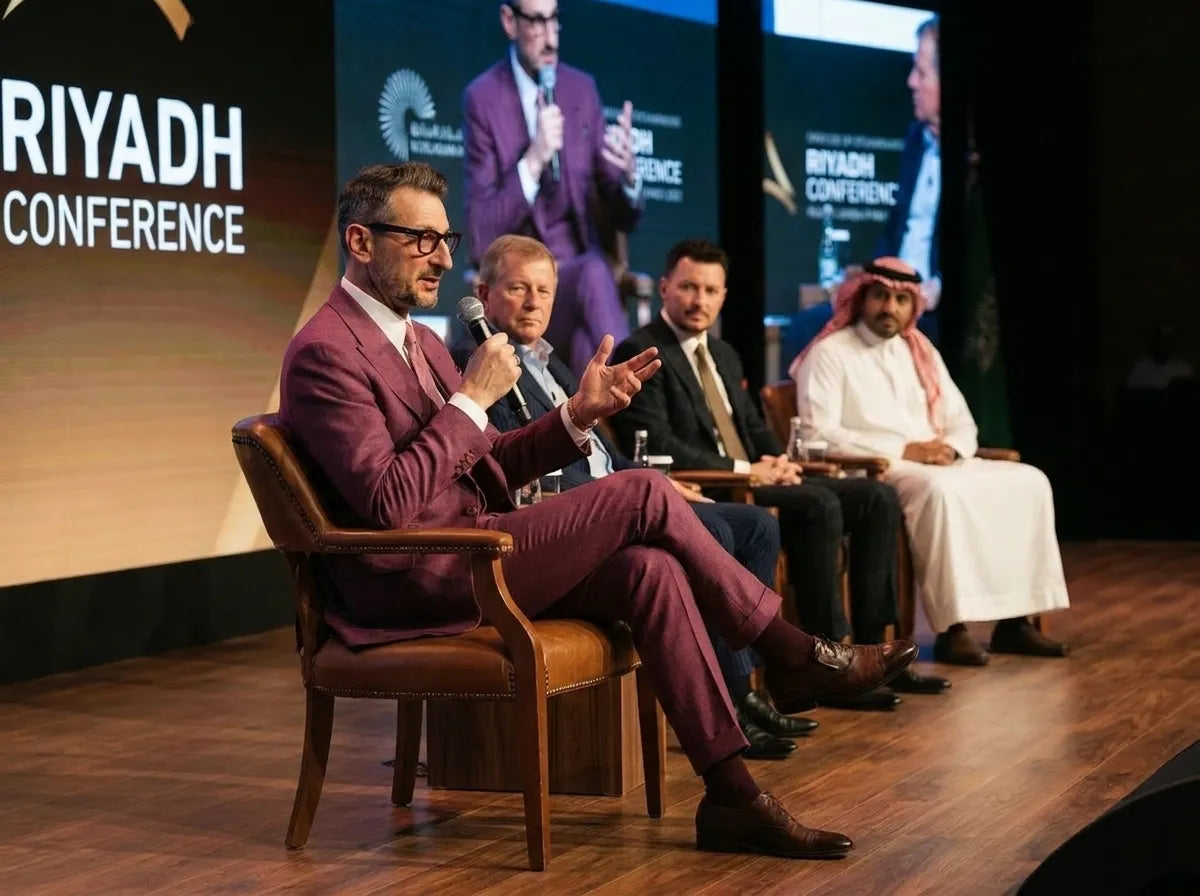
Why Off-the-Rack Suits Fail in Riyadh's Heat (and What Works Instead)
Most off-the-rack suits are built for a mild climate and a standard body. Riyadh offers neither. Between summer highs above 45°C and the constant switch to cold air conditioning, a fused, block-cut suit starts working against you by midday. A suit with a floating canvas chest, cut from your own pattern in open-weave wool, keeps its shape, breathes, and still looks right at six in the evening.
I've been making suits for ten years and have measured men on four continents: CEOs, managing partners, diplomats and founders. One observation holds everywhere. The men who care most about how their suits perform are rarely the ones asking about labels. Riyadh has sharpened that observation considerably.
What Riyadh's heat does to a suit
Riyadh brings summer highs above 45°C and heat for most of the year. Add near-universal air conditioning in boardrooms, hotels and government buildings, and a man moves between two opposing temperature environments several times a day.
Most off-the-rack suits are built for one climate. They're cut on standardised blocks, fused with synthetic interfacing, and finished with machine-worked buttonholes. They look acceptable on a mannequin in a controlled environment. In Riyadh, they fight you.
The fused interfacing, a layer bonded to the chest with adhesive, doesn't breathe. The lining traps heat. The block assumes a relationship between chest, waist and hip that rarely exists in real bodies. By noon in Al Olaya, a man in a ready-made suit looks like he's been sitting in it since Tuesday.
I don't say this to sell against other products. I say it because I've seen what happens when a client who's worn the wrong suit for three years finally puts on one made for him.
Floating canvas vs fused: why construction matters in the heat
Every tailor serious about construction uses a floating canvas chest. Here's what that means in plain language.
The chest piece, a layer of horsehair canvas or wool, sits between the outer cloth and the lining, attached only at specific points. Over weeks and months of wear it softens and moulds to the wearer's chest. The suit gets better with age, not worse, and because nothing is glued, the cloth can breathe.
A fused jacket is bonded throughout. It holds its shape in the shop. After repeated wear, heat and dry cleaning, the bond can weaken and the cloth bubbles, which is very difficult to repair.
When a director at a financial institution in KAFD, or a founder with offices on Al Nakheel, meets the same counterparts week after week, this matters. A suit that softens into its owner communicates something a suit coming apart at its fusing does not.
I use floating canvas construction on every jacket I make. It's not a feature to market. It's a standard I won't drop below. For what else separates a properly made suit from an expensive-looking one, see £500 vs £5,000 suits, explained.

Why off-the-rack patterns don't fit most men
Ready-to-wear suits are cut for a man standing upright, chest square, arms hanging symmetrically. Most men don't stand or sit like that, especially men who've spent fifteen years in leadership roles.
Forward shoulder tilt. One shoulder lower than the other. An athletic chest that narrows sharply at the waist, which I cover in detail in my guide to suits for muscular men. Manufacturers call these builds "non-standard." I simply call them a person.
These are the men I work with most in Riyadh: managing directors, corporate directors and senior partners at international law firms. They've tried the flagship stores, the made-to-measure brands and the airport tailors on business trips. They've spent money. They've been disappointed.
The issue isn't the quality of those products in isolation. It's that standardised patterns cut for a theoretical man rarely fit an actual one. Made-to-measure improves on this but still starts from a block; I explain the difference in bespoke vs made-to-measure in Riyadh.
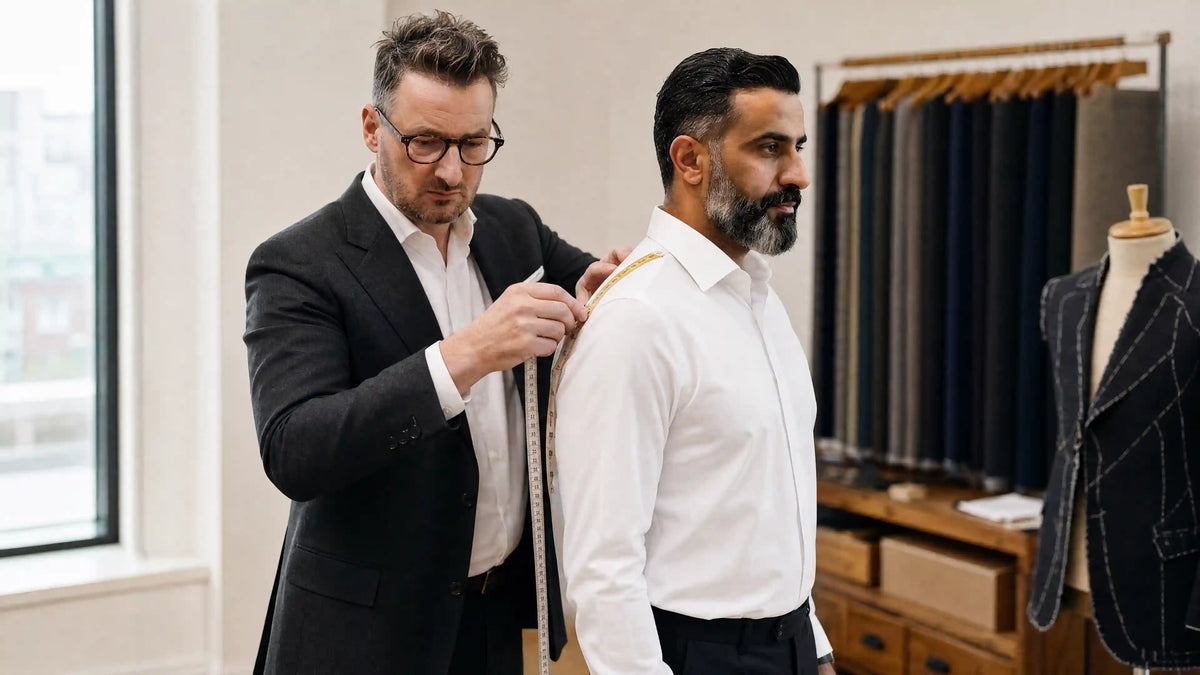
A bespoke pattern starts from zero. On a first appointment I take a full set of measurements, note posture, and watch how a man stands and sits. I record where his shoulder actually falls, not where a block assumes it should. The pattern I cut is his, not a modified version of someone else's.
Best suit fabrics for Riyadh's climate
I work with a small number of mills (Holland & Sherry, Scabal, Loro Piana, Vitale Barberis Canonico and Piacenza) because I know their ranges, how they behave under the iron, and which weights and weaves perform in heat.
For Riyadh commissions I usually reach for open-weave British-milled wool in Super 120s to 150s. The number describes how fine the wool fibre is. These cloths have enough structure to hold a clean line and enough airflow to stay wearable through a full working day. Scabal's tropical ranges perform well in the Gulf, and Holland & Sherry's birdseye weaves hold their shape across temperature shifts better than most.
Synthetic blends are cheaper. They also pill, don't breathe, and feel different to anyone who handles cloth regularly. Across a table from people who've worn good cloth all their lives, that difference is noticed.
The fabric isn't everything. But a hand-cut pattern in the wrong cloth is still a compromise. The cloth and the construction are a single decision.
Why dress matters in Saudi professional culture
There's a dimension to dressing in Riyadh that doesn't apply in the same way in Liverpool or London.
Saudi professional culture reads clothing with precision. The quality of the cloth, the fit of the shoulder, the weight and fall of the jacket are all observed. Not the way a fashion editor appraises a runway, but the way someone who has worn tailored clothing all his life notices whether what's across the table was made properly.
Western executives working with government entities, sovereign wealth funds, family offices and senior officials are guests in a context with its own established codes. The suit is one signal among many, but it's a clear one. For specific occasions, see my guide to Riyadh business event dress codes for men.
The diplomats I've worked with in the Kingdom say the same thing: clothing has to perform without drawing attention to itself. A suit that fits pulls no focus. A suit that doesn't fit tells its own story. Bespoke, in this context, isn't a style choice. It's a professional calculation.
Is bespoke worth the investment?
I'm regularly asked how bespoke compares on cost with the premium end of ready-to-wear. Bespoke is an investment beyond department-store tailoring, and I've set out exactly what it costs and what's included in how much a bespoke suit costs in Riyadh.
What changes is the useful life of the garment. A bespoke suit in good British-milled wool, correctly maintained, lasts ten to twenty years. The canvas improves with wear. Cloth from a serious mill holds its colour and handle far longer. Alterations are straightforward because the pattern is kept and the construction allows for them.
For a managing partner building a working wardrobe, a suit worn hundreds of days a year costs far less per wear than its price suggests. I'm not asking anyone to spend money they haven't considered. I'm asking them to do the arithmetic accurately. I've written more on this in the real benefits of a bespoke suit.
How a bespoke consultation works in Riyadh
I don't work from a shop floor. I never have.
Consultations take place at your office, your home, or my studios at the Royal Albert Dock in Liverpool or Wadi Qortuba in Riyadh. The appointment is private. There's no sales pressure, no commission pushing one cloth over another, and no front-of-house theatre.
For executives in Riyadh, whether an expat on a three-year rotation or a Saudi founder running a regional portfolio, a private appointment fits how they already work. They don't queue. They don't browse. They commission.
The first appointment covers measurements, a posture assessment, and a conversation about the wardrobe being built, not just the first suit. Board meetings in Riyadh? Travel to London, Geneva or Singapore? Social events in both? The suit I cut is an answer to those specific conditions. Cloth selection follows, and I bring samples, not catalogues.

What first-time bespoke actually involves
Many of my clients are commissioning bespoke for the first time, and some arrive with assumptions that need adjusting.
The process isn't slow. A first commission typically takes six to eight weeks from first appointment to final fitting, and for clients travelling between the Gulf and the UK, I schedule fittings around existing trips. The pattern is cut after the first appointment, and a baste fitting, a progress fitting, takes place before final construction. Most clients find the fittings brief and the process straightforward.
I ask a first-time client for one thing: a clear sense of where the suit will be worn. The rest is my job.
The Savile Row standard, in Riyadh
I trained with cutters who came up through the Savile Row system. The hand skills they passed on (pattern drafting, baste cutting, pad-stitching the chest canvas) are the skills I use on every commission.
I don't outsource the cutting or the fitting. The man who takes your measurements makes your pattern. That isn't standard in the industry. It is standard in my studio.
Hand-worked silk buttonholes are a detail most people can't name but immediately notice. They sit differently and age differently. They're one of the clearest signs of whether a jacket was made properly or made to look as if it was. For men whose standing depends on being the real thing, not an approximation of it, that distinction isn't pedantic.
Frequently asked questions
What is the best suit fabric for Riyadh's heat?
Open-weave British-milled wool in Super 120s to 150s, tropical wools and birdseye weaves. They hold a clean line while letting air through. I work mainly with Holland & Sherry, Scabal, Loro Piana, Vitale Barberis Canonico and Piacenza. Avoid synthetic blends, which trap heat.
Why do off-the-rack suits perform poorly in Riyadh?
Most use fused construction, an interfacing glued to the chest that doesn't breathe. Combined with Riyadh's heat and constant moves into air-conditioned interiors, the suit works against you all day. A floating canvas chest and open-weave wool change that materially.
Is a floating canvas suit better than a fused one?
For long-term wear, yes. A floating canvas moulds to your chest over time, breathes, and lasts far longer. A fused jacket looks sharp when new but can bubble after repeated wear, heat and dry cleaning.
Do I need to travel to London for a Savile Row-standard suit?
No. I trained alongside Savile Row cutters and use the same methods (hand-cut patterns, floating canvas chest, hand-worked silk buttonholes) at my studios in Liverpool and Riyadh. The standard travels with the tailor, not the postcode.
How much does a bespoke suit cost in Riyadh?
It depends on the cloth and the construction. I've set out the full pricing and what's included in my Riyadh bespoke suit cost guide.
How long does a bespoke commission take?
A first commission typically takes six to eight weeks from first appointment to final fitting. For clients travelling between Riyadh and the UK, I schedule fittings around existing trips.
I have an unusual build. Can bespoke fit me properly?
That's exactly what bespoke is for. The pattern is built around your measurements and posture, not modified from a block designed for a theoretical average. Forward shoulder tilt, uneven shoulders or an athletic chest aren't problems in my studio. They're just measurements.
Do you work from a shop in Riyadh?
No. Consultations take place at your home, your office, or my private studios at Wadi Qortuba in Riyadh and the Royal Albert Dock in Liverpool. It's a private appointment, not a shop floor.
Does suit quality matter in Saudi professional settings?
Yes. Saudi professional culture reads clothing with precision, and the fit of the shoulder and fall of the jacket are noticed by people who've worn properly made clothing all their lives. A suit that fits pulls no focus. One that doesn't tells its own story.
Book a private consultation
I don't take every enquiry. I work with a limited number of clients each year because the work takes time, and time is the one thing I can't scale.
If you're an executive working in Riyadh, a director based in Liverpool, a groom planning a bespoke wedding suit, or a man who's simply worn the wrong suits for long enough, the process starts with a conversation. There's no obligation at that stage. The obligation comes when the cloth is cut.
Book a private consultation in Riyadh →
You can also find me on Instagram at @michael_frackowiak.
For men whose presence carries consequence.