
The Real Benefits of a Bespoke Suit (From a Tailor's Side)
The real benefits of a bespoke suit are practical, not status: a fit drafted to your body's asymmetries, cloth from serious mills that improves with wear, a hand-stitched floating canvas that can last fifteen to twenty years, a private process built around your diary, and a pattern that gets better with every commission. Worn regularly, a bespoke suit also costs less per wear than a high-street suit.
Let me get something out of the way first. Bespoke isn't about looking richer. It's not about a status logo. It's not about owning a suit your friends can't afford.
If that's the answer you wanted, this article isn't for you, and honestly, neither is my work.
Bespoke is about a garment that disappears on your body. A jacket that does its job in the third hour of a board meeting, on the fourth flight of the month, or in the moment you stand to give the toast at your son's wedding. A suit that stops fighting you and starts working for you.
That's the only benefit that matters. Everything below is the mechanics of how we get there.
What "bespoke" actually means
"Bespoke" is the most abused word in menswear.
Half the brands using it mean made-to-measure: an existing pattern adjusted to your measurements. A quarter mean they let you choose a button colour. A handful mean what bespoke has always meant: a brand-new paper pattern cut from scratch and drafted to your body, stitched by hand through the layers that matter, and fitted several times before delivery.
I work in that last category. It's the standard I learned alongside Savile Row cutters, and the only definition I respect.
So when I talk about the benefits of bespoke, I'm not talking about a marketing word. I'm talking about a 60-to-80-hour process that produces a garment built for one body only. Here's what that process gives you.
The 5 real benefits of a bespoke suit
1. A fit that solves problems you didn't know you had
Every man has asymmetries. Your right shoulder sits lower than your left. Your neck pitches slightly forward from years at a desk. One hip is higher. Your chest is half an inch fuller on one side. For men who train, every one of these is exaggerated.
These aren't flaws. They're facts. Every body has them.
A factory suit ignores all of it. It's drafted for an imaginary average man who doesn't exist. So the shoulder pulls, the collar gapes, and the back rides up when you reach for a glass.
A bespoke pattern is drafted to those asymmetries. When the suit arrives, the collar lies flat against your shirt at every angle. The shoulder seam ends exactly where your shoulder does. You can raise your arms without the jacket lifting with you. It's the same reason the great suits on screen look effortless: they were cut for one man.
The benefit isn't aesthetic. It's functional. You stop adjusting yourself. The suit holds you.
2. Cloth that lives, not cloth that dies
The wool in a high-street suit is blended down to a price. It feels flat, creases sharply, and gives up after eighteen months of dry cleaning.
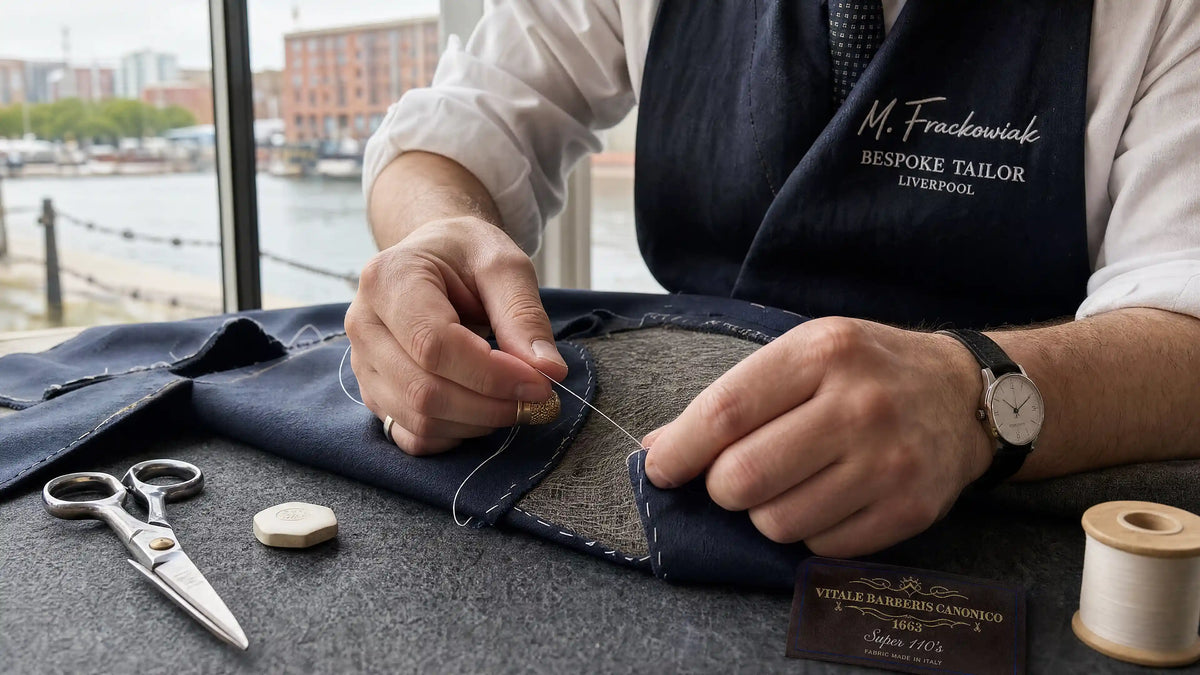
The cloth I work with comes from a handful of mills I trust: Holland & Sherry and Scabal for British-woven cloth, Loro Piana and Piacenza in Italy, and Vitale Barberis Canonico for cloths that can survive a Riyadh August and a Liverpool November in the same wardrobe.
A British-milled wool at Super 130s or finer has a dry, dense handle. It drapes. It releases its creases overnight on a wooden hanger. And it develops a slight patina over the years that no new suit can replicate.
The benefit: you buy fewer suits over your lifetime, and the ones you own get better with age.
3. Construction you can't see, but will feel for twenty years
This is the part most clients only appreciate after their second commission.
Inside a £500 suit is a sheet of fusible interfacing: glue, pressed onto the wool with heat. Fast to produce, cheap to scale, and structurally dead. After repeated dry cleaning the bond can fail, the chest puckers, and a wavy distortion appears across the front that is very hard to repair.
Inside my work is a floating canvas: horsehair and wool, hand-stitched to the cloth with tiny pad stitches across the chest and lapel. The canvas floats inside the jacket and shapes itself to your chest over time. The suit gets better with wear. It learns the contours of your body.
A floating canvas suit, brushed after wearing and dry cleaned no more than once a year, will outlast three or four high-street suits. I have clients in Liverpool and Riyadh still wearing jackets I cut in my first years, and the shoulders sit exactly as they did on day one.
The benefit isn't romantic. It's economic. Measured per wear, quality construction is the cheapest clothing you'll ever own.
4. A process built around your life, not a shop floor
I don't have a shop. I have a studio at the Royal Albert Dock in Liverpool and one in Wadi Qortuba in Riyadh, and I see clients privately at home, at their office, or wherever removes friction from their week.
That matters more than men realise until they've done it once.
A bespoke commission involves several fittings across six to eight weeks. You're choosing cloth, discussing lining colour, deciding lapel width and adjusting trouser break. None of that should happen in front of strangers on a shop floor.
The men I cut for (managing partners, diplomats, founders, executives in KAFD) don't want their wardrobe choices observed. They want the work done privately, on their schedule, in an environment that respects what they're paying for.
The benefit: the process itself becomes part of the value. Not an errand, but a conversation.
5. A relationship that compounds over decades
This is the benefit nobody quantifies, but every long-term client understands.
After your first suit, I know your asymmetries. After your third, I know your posture, your preferences and your wardrobe gaps. By the fifth, I can cut for occasions you haven't mentioned yet, because I've watched your career and life move.
The pattern I draft for you in year one is refined with every commission. Year five fits better than year one. Year ten fits better than year five.
A factory suit is a transaction. A bespoke commission is a relationship that compounds. The benefit is a wardrobe that fits you better at sixty than it did at forty.
Is a bespoke suit worth it, or just expensive suits for show?
This is the objection I hear most, usually from intelligent men who haven't yet owned one.
The honest answer: if you wear a suit twice a year, bespoke is overkill. A good made-to-measure will serve you, and I'll tell you that directly if you ask.
But if your suit does real work, daily, in boardrooms, courtrooms, and in front of investors and ministers, the maths changes. A £1,700 bespoke suit worn 200 days a year for fifteen years costs about 57p per wear. A £500 high-street suit worn 200 days a year for three years before it gives up costs about 83p per wear, and it's making you look tired by 3pm, which has a cost nobody puts on a spreadsheet.
The men I cut for understand this. Their suit isn't an indulgence. It's an instrument, and instruments are bought once, bought well, and looked after.
The price isn't the point. The hours are the point.
Frequently asked questions
What are the main benefits of a bespoke suit?
A fit drafted to your exact body, including its asymmetries; cloth from serious mills that improves with age; hand-stitched floating canvas construction that can last fifteen to twenty years; a private, unhurried process; and a pattern that's refined with every commission.
How much does a bespoke suit cost?
My bespoke suits start from £1,700 in Liverpool and SAR 8,500 in Riyadh, varying with cloth, construction and detailing. A three-piece in Holland & Sherry mohair, for example, is a different number. I'll quote precisely after the first conversation, with no hidden costs.
How long does a bespoke commission take?
Six to eight weeks from first measurement to final delivery, with fittings in between. I won't rush it. The hours are what produce the result.
Is bespoke worth it if I only wear a suit occasionally?
Honestly, no. If you wear a suit twice a year, a quality made-to-measure will serve you well. Bespoke earns its keep when the suit is working for you in rooms where the cut matters.
Will a bespoke suit really last fifteen years?
Yes, if you look after it. Brush it after each wear, hang it on a shaped wooden hanger, dry clean it no more than once a year, and rotate it with at least one other suit.
What's the difference between bespoke and made-to-measure?
Made-to-measure adjusts an existing block pattern to your measurements. Bespoke cuts a new pattern from scratch, drafted to your body. One is alteration; the other is creation. The hours, and therefore the price, reflect the difference.
Can you make clothing other than suits?
Yes: jackets, trousers, overcoats, shirts, dinner suits, thobes and waistcoats. The principles are the same: a hand-cut pattern, mill cloth, and floating construction wherever the garment needs it.
Where can I meet you?
At the Royal Albert Dock studio in Liverpool, the Wadi Qortuba studio in Riyadh, or privately at your home or office, whichever removes friction from your week.
Do you take international clients?
Yes. I see clients across the GCC, Europe and occasionally further. The two studios are the anchor points, but the work travels.
Why don't you have a shop?
Because the men I cut for don't want to be observed choosing cloth on a shop floor. The work has always been private. That's the tradition, and it's part of why the work is worth what it costs.
A final word
I don't sell suits. I cut clothes for men whose presence carries consequence, and the suit is only the visible part of that work.
If you've read this far, you're not browsing. You're considering. That's the right way to start.
When you're ready, I'll put the kettle on, or the gahwa pot, depending on the studio, and we'll talk. No pressure to commission. No pitch. Just a conversation to find out what you actually need, and whether I'm the right cutter for it.
Start the conversation in Liverpool or Riyadh, or find me on Instagram at @michael_frackowiak.
— Michael

